

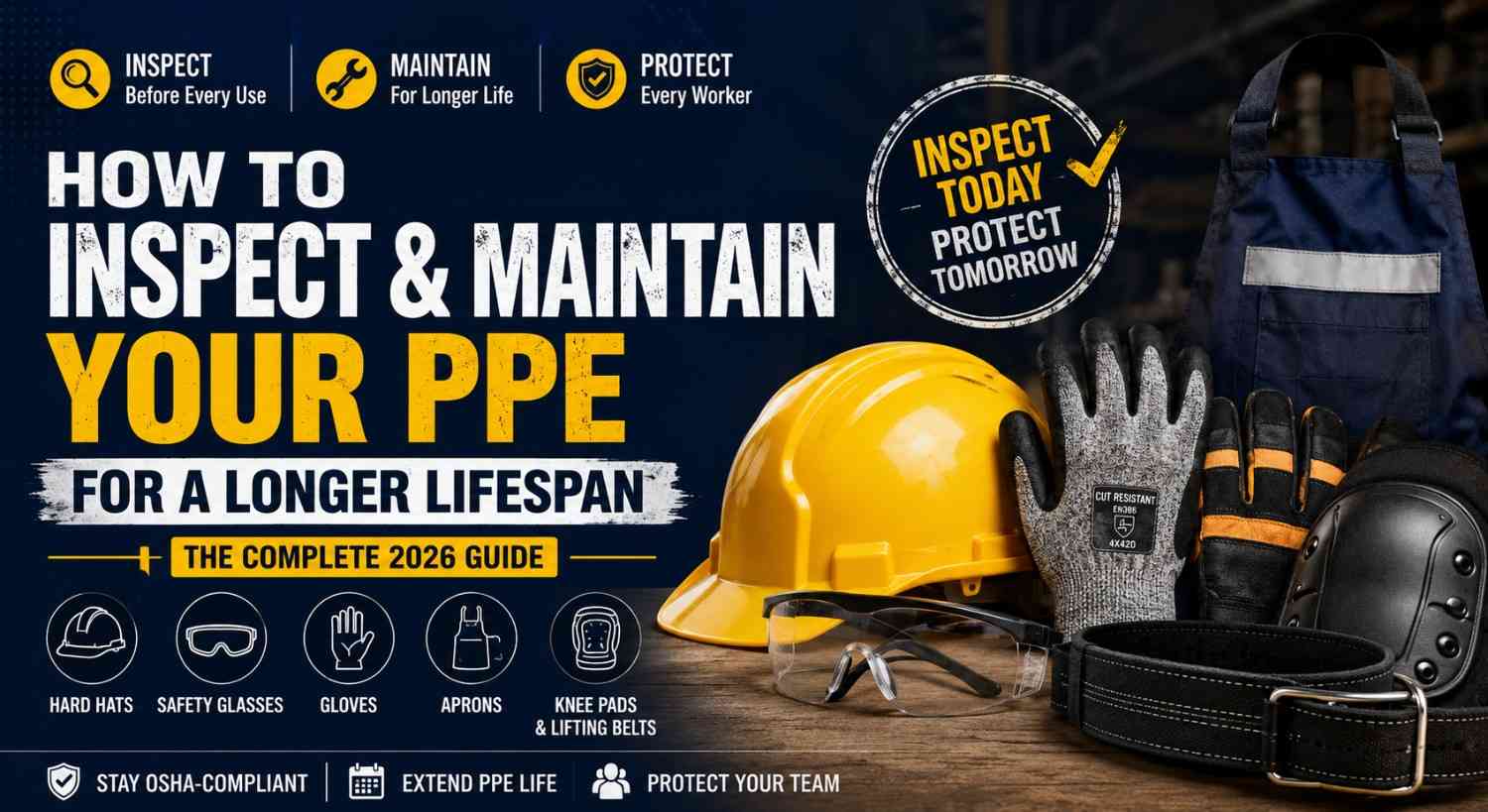
Your PPE is only as good as the last time you examined it – and the majority of workplace injuries occur not because workers lacked protection, but because the protection they trusted had quietly failed them. Knowing how to properly inspect and maintain your personal protective equipment is an essential ability, whether you manage a big construction group or gear up alone every morning. It is the difference between going home safely and not going home at all.
It explains how to examine, maintain, and extend the life of the personal protective equipment (PPE) your team uses every day, from hard helmets to cut-resistant gloves to safety glasses, so that you are never caught off guard by gear that appears to be fine but is not.
Why PPE Maintenance Is the Safety Step Most Teams Skip
Consider your personal protective equipment (PPE) to be like truck brake pads. They operate brilliantly until they don’t—and by then, it’s too late. The issue is that deteriorating PPE rarely makes itself known. A hard hat with internal cracking appears identical to a sound one. A pair of nitrile gloves with micro-perforations feels the same on your hands. Safety glasses with extensive scratches will still fit on your face; however, they will not shield your eyes as well.
According to OSHA, PPE that is defective, badly maintained, or past its service life may provide little to no protection, but it is still being worn since it was not removed from rotation.
You May Like – The Real Cost of Workplace Injuries Without PPE
The Simple Three-Tier Inspection Model
Before going into particular products, every safety-conscious team should conduct inspections at three levels:
Pre-use inspection – performed every time before the equipment is turned on. Takes 60 seconds. Non-negotiable.
Periodic inspection — A more thorough review performed weekly or monthly, depending on the frequency of use and the environment. More structured and documented.
Post-incident inspection – Any time PPE is subjected to a large impact, chemical splash, or other event, it is removed from the floor immediately for thorough evaluation before being used again.
If something looks out of place during any of them, you mark it as out of service. Rather than “probably fine.” No longer in service.
Hard Hats and Bump Caps: Head Protection That Actually Works
Head protection is probably the most obvious piece of personal protective equipment on a job site, which is why it is often overlooked. Every morning, workers pick the same hard hat off the hanger without looking twice. That habit has to be altered.
How to Inspect a Hard Hat
Start with the shell. Hold it up to a light source and search for cracks, dents, powdery discoloration (an indication of UV deterioration), or surface gouges. Run your hands across it; your fingertips will detect anomalies that your eyes may miss.
Turn it over and inspect the suspension system inside. The webbing and headband absorb the impact energy. Check for worn out straps, broken or bent components, and headbands that have lost tension. Press gently on the shell, and it should bounce back. If it feels fragile or does not return to shape, it is finished.
What About Bump Caps?
Bump caps have a different and more limited purpose than hard hats: they protect against minor knocks and scrapes in low-hazard locations such as warehouse aisles or food processing rooms, rather than falling object impacts. Inspect them in the same way: inspect the shell for cracks, the inside cushioning for compression or degeneration, and the fit mechanism to ensure appropriate function. Bump caps are frequently forgotten in maintenance routines due to their use in lighter-duty applications; don’t allow this to happen.
Cleaning and Replacement
Clean both hard hats and bump caps with mild soap and warm water. Never use solvents, paint thinners, or petroleum-based cleansers; they erode the shell material without causing visible damage, which is the worst-case scenario. Most manufacturers advocate replacing the suspension every 12 months and the shell every 2-5 years, regardless of evident wear. If your workforce works outdoors all year, UV exposure accelerates degradation; opt for a shorter replacement window.
Safety Glasses, Goggles, and Face Shields: Protecting the Eyes and Face
Eye injuries are among the most preventable workplace accidents in the United States, and they continue to occur at alarming rates, owing mostly to workers wearing poor-quality eye protection or not wearing it at all because it is inconvenient or impractical.
Inspecting Safety Glasses
Safety glasses should be inspected before each use. Inspect lenses for scratches, pitting, or cracks. This is more important than most people realize: scratched lenses not only impair clarity but also cause glare and optical distortion, all of which can lead to errors. According to ANSI/ISEA Z87.1 standards, scratched or pitted lenses require rapid replacement. Examine the frames for cracks and the temple arms for bends that jeopardize appropriate fit – if safety glasses do not sit properly on the face, they are not safeguarding the face.
Inspecting Safety Goggles
Safety goggles provide a sealed fit against the face, making them ideal for splash, dust, and chemical hazard conditions. Inspect the lens in the same way that you would with safety glasses. Then, pay particular attention to the seal, which is a foam or silicone gasket that surrounds the face contact region. A squeezed, cracked, or deformed gasket will not seal well, defeating the objective of using goggles instead of glasses. Check the strap for suppleness; a stretched-out strap indicates loose-fitting goggles, which is a safety hazard.
Inspecting Face Shields
Face shields cover the complete face and are often used in conjunction with safety glasses or goggles, rather than as a stand-alone replacement. Examine the visor for scratches, cracks, and chemical haze (common in laboratories and chemical handling areas). Check the headgear and ratchet adjustment mechanism to ensure smooth operation and a secure fit. A face shield that changes during the workday gives variable covering.
Cleaning Eye and Face Protection
For all three, clean the lenses with a soft, lint-free cloth and an authorized lens cleaner. Paper towels always scratch lenses. Use suitable wipes to disinfect the contact surfaces of goggles and face shields, particularly in multi-user scenarios. Eye protection should be stored in a protected container or sleeve rather than unsecured in a tool bag where lenses will scratch against everything else.
Gloves: The Most Used and Most Abused PPE on Any Jobsite
Workers put on and remove gloves dozens of times per day. They get crammed in pockets, left on benches, and dragged about damp. It’s not surprising that glove maintenance is overlooked – but hands are the most frequently injured body part in American workplaces, and appropriate glove examination is a direct path to lowering those numbers.
Cut-Resistant Gloves
Cut-resistant gloves provide protection against lacerations caused by sharp materials, blades, and edges. Inspect the cut-resistant fibers thoroughly, looking for areas where the protective material has worn through or thinned, particularly on the palm and fingertips where contact is most intense. If you can see through the material in any region, the glove is no longer approved for protection. Inspect the seams for separation and the cuff for fraying.
Heat-Resistant Gloves
Heat-resistant gloves are only effective if their insulating layers are intact. Inspect for burn scars, blistering, and spots where the outer shell has stiffened or fractured due to frequent heat exposure. Flex the glove entirely; it should remain pliable. A stiff glove has reduced insulation and poses a burn risk. Moisture transmits heat directly to the skin, therefore never use wet or damp heat-resistant gloves.
Leather Gloves
Leather gloves are reliable for general-purpose protection, but they degrade in ways that are not usually visible. Look for cracking, stiffness, and worn-thin spots, especially on the palm. Check the stitching along the seams for separation. Leather gloves should be treated with a suitable leather conditioner on a regular basis to avoid cracking and greatly lengthen their useful life. Never dry leather gloves near direct heat since it causes quick cracking.
Latex and Nitrile Gloves
Latex and nitrile gloves are normally used once and then discarded, but in some cases they are reused for brief periods of time. Before applying either type, hold them up to a light source to check for pinholes or thin patches. Check for discolouration or swelling on nitrile gloves used in chemical handling, as this indicates chemical absorption and deterioration. When in doubt about disposable gloves, use a new pair; the expense of a glove is never worth the danger.
General Safety Gloves
Inspect the entire glove surface for cuts, abrasions, and worn patches when using safety gloves for typical industrial or construction jobs. Pay attention to the grip material on your palm; a worn grip implies you have less control over your equipment and materials, which is a hazard in itself. Wash according to product instructions and let dry completely before storing; moist gloves stored in enclosed places grow bacteria and degrade faster.
Aprons and Disposable Gloves: Food Safety PPE That Needs Attention Too
PPE in food handling areas is constantly exposed to moisture, cleaning agents, heat, and contaminants. In this context, maintenance encompasses both hygiene and physical integrity.
Inspecting and Maintaining Aprons
Aprons used in food safety and processing facilities should be checked for tears, holes, and damage to the waterproof or chemical-resistant covering. A torn apron not only exposes the wearer, but also poses a contamination danger to the food environment. Check straps and ties for fraying and ensure proper fastening. Wash according to the manufacturer’s instructions after each use; in high-risk food environments, sanitizing after cleaning is common practice.
Disposable Gloves in Food Handling
Disposable gloves for food handling should never be reused. Before putting on each glove, inspect it for any faults, tears, or compromised material. Change gloves when switching jobs (particularly from raw to ready-to-eat foods), after touching contaminated surfaces, and at regular intervals throughout protracted work. Keep gloves clean and dry; gloves that are stored in humid or hazardous environments might become contaminated before they are ever worn.
Knee Pads and Lifting Belts: The Often-Overlooked Support PPE
Support PPE such as knee pads and lifting belts may not receive nearly as much maintenance attention as they could, partly because they are not connected with acute, dramatic injuries in the same way that head or eye protection is. However, cumulative musculoskeletal damage from unsupported kneeling and lifting is one of the most costly injury categories in US businesses.
Knee Pad Inspection and Care
Inspect knee pads for padding compression; foam or gel that has permanently flattened is no longer useful at absorbing impact or distributing pressure. Look for cracks in the shell (if it’s a firm shell). Inspect the straps for suppleness and Velcro for a secure closure. Clean fabric components according to the manufacturer’s instructions; damp or saturated padding loses effectiveness and takes a long time to dry, promoting bacterial growth.
Lifting Belt Inspection and Care
Check lifting belts for stitching integrity, especially at stress spots where the belt meets the buckle or closure hardware. Look for cracks in leather belts and delamination in foam-core belts. Check buckles and closures for proper operation; a lifting belt that loosens mid-lift provides no support when it counts the most. Lifting belts should be stored flat or rolled loosely, rather than folded or squeezed, as this might cause permanent creases and degrade the construction.
Building a Maintenance Routine That Actually Gets Done
Individual inspections are important, but a systematic approach is what continually protects the entire workforce.
Document Everything
Every item of reusable PPE should include a log that includes the date it was issued, who it was assigned to, the inspection dates, and any incidents. Even a basic shared spreadsheet works. When a hard hat needs to be replaced or a pair of cut-resistant gloves shows signs of wear, a recorded approach makes the decision automatic rather than subjective.
Train Workers on Inspection, Not Just Use
Every item of reusable PPE should include a log that includes the date it was issued, who it was assigned to, the inspection dates, and any incidents. Even a basic shared spreadsheet works. When a hard hat needs to be replaced or a pair of cut-resistant gloves shows signs of wear, a recorded approach makes the decision automatic rather than subjective.
Replace Before It Breaks, Not After
Plan ahead of time to replenish personal protective equipment. The cost of replacing a pair of leather gloves or a bump cap on time is a fraction of the whole cost of a single injury claim, including medical, legal, productivity, and morale expenses. When safety managers can present concrete numbers to leadership, discussing replacement budgets becomes a lot easier.
Conclusion: Maintained PPE Is a Culture, Not a Checklist
Properly maintained PPE communicates a vital message to your team: that you care about their safety enough to do the unpleasant labor rather than simply post a poster. Workers notice when gear is clean, functioning, frequently inspected, and replenished on time — and they respond by wearing it, wearing it appropriately, and caring about their teammates’ gear as well.
The behaviors in this guide do not necessitate a large budget or hours of extra time. They require consistency, documentation, and a true dedication to treating every piece of equipment, from a $10 pair of nitrile gloves to a $60 pair of heat-resistant gloves, as if it were the last line of defense.
Start today. Take out your existing PPE inventory. Take anything that is damaged, worn, or has passed its service life out of rotation right now. Create a basic inspection log for your reusable equipment. Also, if your team hasn’t conducted a hands-on inspection walkthrough in the last quarter, plan one this week.
Your crew isn’t just wearing gear; they rely on it for their safety every day. Make sure it is worthy of that confidence.
[…] happen where the risk is. Fitness-for-duty confirmations, PPE checks, and policy acknowledgments are captured at clock-in — timestamped, tied to the worker and the […]