

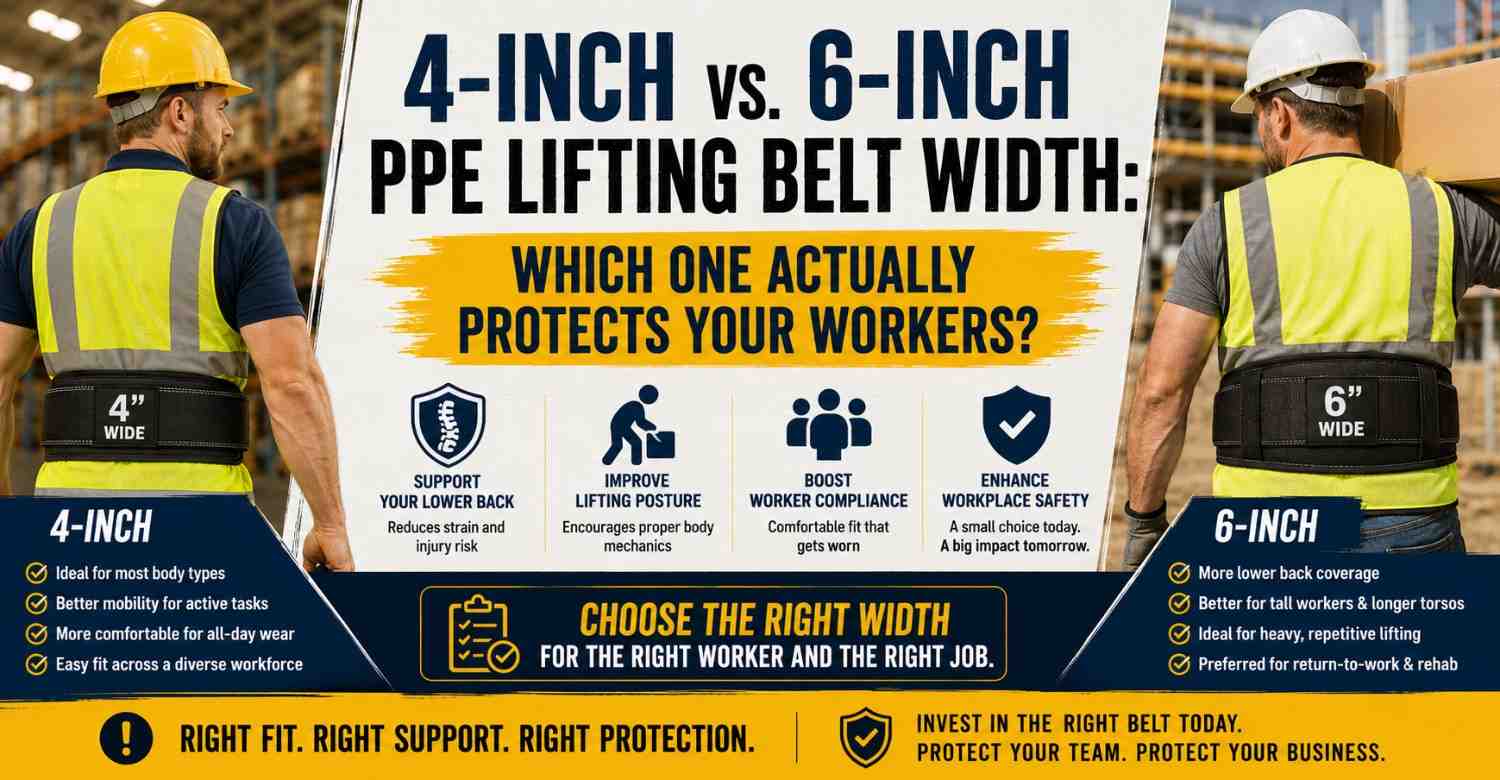
You are looking for back support belts for your team and have run into a wall: 4 inch or 6 inch? It’s more than simply a shopping decision; it’s a workplace safety issue, and making the wrong choice means either under-protecting your employees or purchasing gear that no one wears because it’s uncomfortable. Here’s a straightforward summary to help you make the proper decision the first time.
What Is a PPE Lifting Belt and Why Does Width Matter?
A personal protection equipment (PPE) lifting belt, also known as a back support belt, lumbar support belt, or industrial lifting belt, is a device worn across the lower back and abdomen while performing manual material handling jobs. They are commonly used in warehouse, construction, logistics, manufacturing, and healthcare settings where personnel frequently lift, transport, or reposition goods. Read 20+ Types of PPE and Their Applications Across Industries.
How the Belt Actually Protects Workers
A back support belt operates on two levels. First, it applies external compression and warmth to the lumbar region, increasing posture awareness and encouraging optimal lifting technique. Second, it serves as a physical reminder — a tactile indication that urges workers to activate their core before a lift, similar to how a seatbelt increases a driver’s awareness of speed.
The width of the belt influences how much of the lumbar spine and stomach area is protected and supported. More coverage isn’t always better, but in the correct body type and job capacity, it can make a big difference.
The Two Most Common PPE Belt Widths
4-inch belts provide tailored lumbar support while maintaining decent mobility, making them suited for the majority of body types and tasks.
6-inch belts provide more coverage of the lower back and are better suited to personnel with larger torsos or tasks that require prolonged static lifting postures.
Both widths are commonly available in elastic, neoprene, and mesh materials, with adjustable Velcro or hook-and-loop closures.
The Case for the 4-Inch PPE Lifting Belt
The 4-inch back support belt is the most often utilized width in industrial settings, and safety officials and occupational health professionals recommend it as the default width in the majority of organizations.
Comfortable Across a Range of Body Types
Most workers, regardless of height or build, use a 4-inch belt that fits perfectly between their lower ribs and the top of their hips. It does not ride up during movement or dig into the hips while bending. For workers who are on their feet for 8-12 hour periods, comfort has a direct impact on compliance; a belt that sits incorrectly is removed, and a belt that has been removed provides no protection.
Consider this: the finest personal protective equipment is the one that workers wear. A 4-inch belt worn all day outperforms a 6-inch belt removed by 10 a.m.
Better Mobility for Active Work Tasks
The 4-inch belt enables for a wider range of motion in contexts where workers must twist, reach, walk, or climb in addition to lifting, such as warehouse order pickers, construction laborers, or delivery drivers. A narrower profile provides less friction with the hips and less restriction on the trunk during dynamic movement.
This is especially crucial in roles where uncomfortable postures are prevalent. A belt that restricts natural movement too much can raise the risk of strain by requiring workers to adopt compensatory postures.
Read – The Role of Lifting Belts in Workplace Safety
Easier to Fit Across a Diverse Workforce
If you are outfitting a team with a variety of body types — varying heights, waist widths, and torso lengths — the 4-inch belt is significantly more adaptable in terms of universal fit. Most manufacturers offer 4-inch belts in a wide range of sizes (S to 5XL), allowing for bulk buying without the requirement for extensive individual fitting.
The Case for the 6-Inch PPE Lifting Belt
The 6-inch back support belt serves a real and vital purpose in specific occupational settings. It is not a one-size-fits-all update, but for the appropriate worker in the right function, it provides significant benefits.
Greater Lumbar Coverage for Larger-Framed Workers
Workers with a longer torso or a wider abdominal profile may find that a 4-inch belt does not fully support their lower lumbar region. The 6-inch belt closes the gap by covering a larger area of the lower back and delivering more uniform compression across the lumbar vertebrae.
The 6-inch belt is a proper fit for a worker who is 6’2″ or taller, or has a longer-than-average space between the rib base and hip crest.
Better for Sustained, Heavy Manual Handling
In jobs that require repetitive heavy lifting of objects greater than 25 kg, such as furniture removal, steel construction, or pallet stacking, the extra surface area of a 6-inch belt provides more consistent abdominal compression throughout the lift cycle. Workers in these circumstances frequently claim that the broader belt lowers the sensation of lumbar weariness after a long workday.
A 6-inch belt is comparable to a larger orthopedic brace. It does not increase your strength, but it does protect more of the vulnerable area for a longer period of time, which is very useful in high-load, high-repetition conditions.
Useful for Post-Injury or Rehabilitation Work Duties
Occupational health professionals may propose broader back support belts for workers returning to modified responsibilities following a back injury. The 6-inch profile provides additional psychological confidence and physical warmth to the lumbar area, allowing for a gradual return to manual handling tasks. You make like – The Real Cost of Workplace Injuries Without PPE.
4-Inch vs. 6-Inch PPE Belt: Head-to-Head Comparison
| Feature | 4-Inch Belt | 6-Inch Belt |
| Best worker profile | Most body types, average torso | Taller workers, longer torso |
| Mobility during dynamic tasks | High | Moderate |
| Lumbar coverage area | Targeted | Broad |
| Compliance (likelihood of being worn) | Higher (more comfortable) | Lower if incorrectly sized |
| Ideal task type | Mixed manual handling, dynamic roles | Heavy repetitive lifting, static postures |
| Rehabilitation / return-to-work use | Adequate | Preferred |
| Ease of bulk procurement | Easier | Requires more individual fitting |
How to Choose the Right Width for Your Workplace
There is no uniform answer; the best option depends on your staff and work environment. This is a realistic framework.
Step 1: Assess the Task
Start with the job, not the individual. Question: Are workers performing dynamic, multi-directional jobs (reaching, twisting, and walking)? Or are they lifting large things repeatedly in a more static posture?
For dynamic jobs, opt for a 4-inch size for better mobility.
For heavy, repetitive lifting, choose a 6-inch covering.
Step 2: Assess the Worker
Once you have defined the work profile, consider the individual. Measure the torso length from the top of the hip crest to the bottom of the rib cage. If that measurement allows for a 6-inch belt to be worn comfortably without riding up or rubbing against the ribs, it is a viable alternative.
A 4-inch belt is a safer and more comfortable fit for workers with torso measurements of less than 7-8 inches in this zone.
Step 3: Pilot Before You Procure
Before ordering 200 units in either width, do a two-week pilot with a representative sample of workers from various roles and body shapes. Assess compliance (are employees truly wearing the belts?), comfort input, and any reported incidents. A pilot’s data is significantly more useful than a spec sheet.
Common Mistakes Employers Make When Sourcing PPE Lifting Belts
Even safety-conscious procurement teams make common mistakes when specifying back support belts.
Choosing Width Based on Price Alone
The 4-inch belt is generally cheaper and easier to get in bulk — but purchasing it only for economic reasons, without regard for task type or worker fit, is a false economy. A belt that does not fit the job profile will not be worn, will not protect against injuries, and will not withstand a liability claim.
Ignoring Heat and Breathability
Neoprene 6-inch belts are warm and supportive, but they become intolerable by midday in hot locations such as foundries, bakeries, and outdoor summer labor sites. In these conditions, a mesh or elastic 4-inch belt with adequate airflow will provide significantly better compliance than a larger neoprene choice.
Skipping Individual Fitting
A one-size-fits-all approach is problematic, especially for 6-inch belts. Workers who are inadequately fitted end up with belts that slide down, roll at the edges, or compress the wrong area totally, providing no ergonomic benefit and potentially causing discomfort.
Our Verdict: Which Width Should You Specify?
For most settings, the 4-inch PPE lifting belt is a good place to start. It works for the widest range of body shapes, supports a wide range of manual handling jobs, and results in higher compliance because workers find it pleasant enough to continue using.
The 6-inch belt is appropriate for situations with tall or larger-framed workers performing sustained, heavy lifting, as well as return-to-work protocols where occupational health recommends additional lumbar support.
The essential lesson is that the breadth of a back support belt is determined by fit rather than hierarchy. A 6-inch belt is not “better” than a 4-inch belt; it is just larger, and it only matters when the person wearing it has the torso to fill it properly.
Ready to Specify the Right Belt for Your Team?
Do not leave back protection to chance. Whether you are outfitting a warehouse team of 20 or a construction site of 200, the proper procedure is to assess the assignment, evaluate the worker, and pilot before purchasing.
Speak with a competent occupational health adviser or ergonomics specialist to obtain a full manual handling risk assessment; this is the most reliable way to identify the appropriate PPE for your unique environment.