

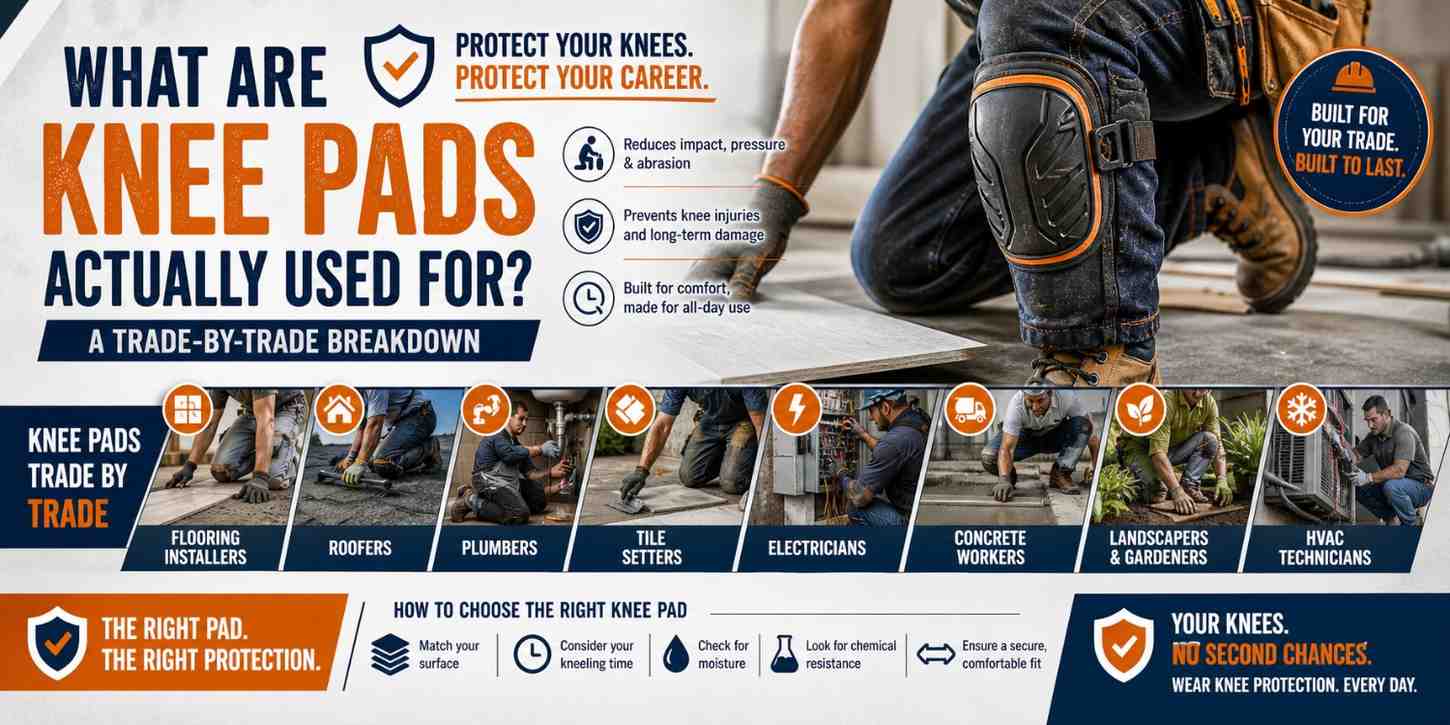
Every trade worker bends, kneels, and crouches, but not every knee pad is designed for every situation. This article explains who requires knee pads, why they are important, and which type is appropriate for each trade. Your knees do not get second chances. When the cartilage wears down, it does not regrow. The right knee pad is the simplest way to protect one of your body’s most often utilized joints.
What are Knee Pads
Knee pads are a type of PPE and intended to protect the knee joint from impact, pressure, and abrasion. They protect the kneecap and surrounding tissue when working on hard or rough surfaces.
Most people believe knee pads are only for flooring installers. That is not true. Plumbers, roofers, gardeners, construction workers, and even healthcare assistants all wear knee protectors on the job.
Why Knee Pads Matter
Kneeling on hard surfaces puts a lot of pressure on your knees. According to studies, kneeling on concrete can cause up to 150% of your body weight to be concentrated on the kneecap.
Over time, repeated kneeling without protection might lead to major difficulties. These include bursitis (fluid-filled swelling), prepatellar tendinitis, and early-onset osteoarthritis. These aren’t small inconveniences. They can bring a career to an end.
Read – Why Knee Pads Are Essential for Safety and Comfort
What Happens Without Knee Protection?
Without kneepads, the small layer of fluid between your kneecap and skin is crushed repeatedly. The bursa sac, or tiny fluid cushion, becomes irritated. This ailment is known as bursitis and is highly frequent among trade workers. It does not happen overnight. It accumulates during months and years of unprotected kneeling. By the time pain becomes visible, the damage has already been done.
What Knee Pads Actually Do
A good knee pad does three objectives. First, it spreads pressure over a larger region, so no single place receives all of the force. Second, it absorbs the impact when you swiftly drop to your knees. Third, it keeps the skin safe from rough, abrasive surfaces such as concrete, tile grout, and gravel.
The Main Types of Knee Pads
Before we start trading, you should be familiar with the basic types. Each type is designed for a certain type of job.
| Type |
Best For |
Key Feature |
| Foam / Soft Pad | Light-duty, gardening, DIY | Lightweight, flexible, comfortable for short sessions |
| Hard Cap | Flooring, tile, construction | Rigid outer shell deflects sharp debris and screws |
| Gel-Filled | Long kneeling sessions, plumbing | Gel molds to the knee and reduces fatigue over hours |
| Hybrid (Hard + Gel) | Roofing, concrete work | Impact-resistant shell with comfortable gel interior |
| Strap-On Heavy Duty | Demolition, electrical work | Stays put under heavy movement; thick padding |
| Built-In (Pant Pocket) | Landscaping, HVAC, crawlspace work | No straps, inserts into work pants; sleek and snug fit |
| Waterproof / Chemical-Resistant | Plumbing, pool installation, cleaning | Sealed shell resists moisture and chemical splash |
Knee Pads Trade by Trade
Each trade requires a unique kneeling position, surface kind, and risk level. Here’s what you should know about each one.
Trade 01 – Flooring Installers
Almost no other trade requires more time on one’s knees than flooring installation. They spend hours kneeling on concrete subfloors, hardwood floors, and tile adhesive. The greatest risk is chronic pressure on the kneecap. Hard flooring surfaces, particularly concrete, squeeze the bursa sac with each minute of kneeling. Over a career, this causes chronic joint injury. Flooring workers also confront significant risks. Staples, nails, tile shards, and tack strips are commonplace. A basic foam pad will not protect against them. Deflecting debris requires a strong outer cap.
The best knee pad type is hard-cap with gel interior. The shell protects against sharp items. The gel helps to spread pressure over lengthy periods of time.
Trade 02 – Roofers
Roofers operate on slanted, rough, and sometimes heated surfaces. They spent the entire day kneeling on asphalt shingles, gravel, and metal panels. The angle of the roof alters the pressure pattern. Your knee does not sit flat; it digs into the surface at an angle. This creates a concentrated pressure point that soft foam cushions cannot withstand. Heat is also a factor. In the summer, asphalt shingles can achieve temperatures of 70°C (160°F). A knee pad with a heat-resistant base will protect your knee from burns and abrasion. Roofers also relocate frequently. A knee pad that shifts, slides, or bunches up provides a tripping hazard on a slope. Secure straps are not negotiable.
The best knee pad type is a heavy-duty strap-on hybrid with a non-slip foundation. Look for heat-resistant fabrics and non-migratory double-strap systems.
Trade 03 – Plumbers
Plumbers work in cramped locations including under sinks, crawlspaces, and next to bathtubs. Surfaces vary considerably. One job involves warm bathroom tile. The following step is on cold concrete in the basement. Water and moisture remain constant. A regular foam pad soon absorbs water, becoming heavy, chilly, and unsanitary. Plumbers want a watertight outer shell that can be easily cleaned. Crawlspace work presents another challenge. Plumbers frequently have to pull themselves forward on their knees. A knee pad that hooks or drags on concrete can cause falls and eventually pull skin off the knee.
The best knee pads are waterproof gel-filled and have a smooth, low-profile shell. Gel keeps up well in long, confined sessions. The sealed surface can withstand moisture and grime.
Trade 04 – Tile Setters
Tile setters work with freshly placed adhesive and grout. These surfaces are irregular, damp, and studded with tile edges. The uneven surface ensures that the knee never sits flat. Small tile edges can cut right through a thin foam cushion. Grout residue hardens quickly and might scratch the skin if a pad slips during use. Tile work also necessitates a lot of lateral mobility. A knee pad that grips the surface too tightly will cause the worker to slow down. One that slips too easily causes instability. Balance is essential.
The best sort of knee pad is hard-cap foam with a textured non-slip base. The cap withstands tile edge pressure. The base offers just enough grip for controlled movement.
Trade 05 – Electricians
Electricians stoop to pull wire, operate inside panels, and run floor-level conduit. Kneeling sessions are usually shorter than flooring or tile work, although they occur on rough concrete and metal. Electrical conductivity presents a particular risk to electricians. A typical foam or gel pad presents no risk. However, workers near active circuits or damp areas should be cautious of pad materials. Electricians alternate between kneeling and standing often. A knee pad with bulky straps or thick shells might impede transitions and catch on conduit or cable trays. The most effective design is thin but durable.
The best knee pads are those with built-in pant pockets or slim strap-on firm foam. Low profile allows for quick movement. Durable enough for concrete and metal surfaces.
Trade 06 – Concrete Workers
Concrete workers stoop to trowel, seal joints, and finish slabs. Fresh concrete is caustic. It includes calcium hydroxide, which is extremely alkaline and can cause chemical burns on unprotected skin. This is one of the most commonly underestimated risks in construction. Workers who kneel in wet concrete without sufficient protection may acquire rashes or chemical burns to their knees. Standard foam pads provide no chemical barrier. Concrete finishing necessitates smooth, controlled movement across the surface. A knee pad that leaves imprints or drags across damp concrete damages the polish.
The best knee pad type is a chemically resistant waterproof knee pad with a flat, smooth foundation. Look for pads designed exclusively for wet concrete work.
Trade 07 – Landscapers & Gardeners
Landscapers and gardeners kneel on dirt, gravel, mulch, and pavers. The surface is softer than concrete, although it remains uneven and frequently moist. The key risk here is cumulative exposure, not pressure. Gardeners kneel for hours on end throughout the workday. Without padding, this results in slow-developing bursitis, which many gardeners dismiss as “just sore knees.” Rocks and buried debris in the earth can also cause injuries from abrupt impacts. When you slide down swiftly, a buried stone under the kneecap can bruise or shatter it.
The best knee pads are made of lightweight foam or gel and have a waterproof basis. The most important consideration is comfort over long sessions. The waterproof base can tolerate moist soil and wet grass.
Trade 08 – HVAC Technicians
HVAC technicians work in tight locations such as crawlspaces, attics, and mechanical rooms. They kneel on metal, concrete, and insulation battens. They also navigate tight ducting passages on all fours. Sheet metal edges provide a considerable hazard. Exposed duct edges can cut directly through a thin knee pad and into the knee. A stiff cap is required in ducting environments. Insulation fibers, particularly fiberglass, can irritate the skin. A sealed knee pad prevents fibers from becoming embedded in the knee area.
The best sort of knee pad is a slim hard cap built-in or strap-on with a sealed shell. A low profile is essential for navigating confined spaces.
How to Choose the Right Knee Pad
Choosing the wrong knee pad is almost as harmful as not wearing one. Here’s a simple checklist to help you choose the best one for your profession.
- Surface hardness: Concrete and metal require a firm outer covering. Soil and carpet can withstand foam or gel pads.
- Session duration: If you kneel for more than 30 minutes, gel padding is worth the extra money.
- Moisture: Any wet work necessitates a waterproof or sealed outer layer.
- Chemical exposure: Wet concrete, adhesives, and solvents require chemically resistant materials.
- Movement frequency: Trades that stand and kneel frequently require a low-profile or built-in pad that does not impede movement.
- Fit and strap security: A sliding knee pad poses a higher risk than no knee pad. Before you buy, test the straps.
Final Verdict
Knee pads are designed to protect one of the most vulnerable joints in any trade worker’s body. They’re not a luxury. They are a practical, low-cost tool that can help you avoid years of chronic pain and costly medical therapy. The key is to select the correct type for your trade. A flooring installer needs something different than a roofer. A plumber’s needs differ from those of a landscaper. One pad does not cover all jobs. Use the trade-by-trade breakdown in this guide to match your working conditions to the appropriate level of protection. Then wear them. Each session. From day one.
Don’t wait till pain makes you quit working. Check your knee protection setup immediately to ensure it reflects the actual hazards in your trade.