

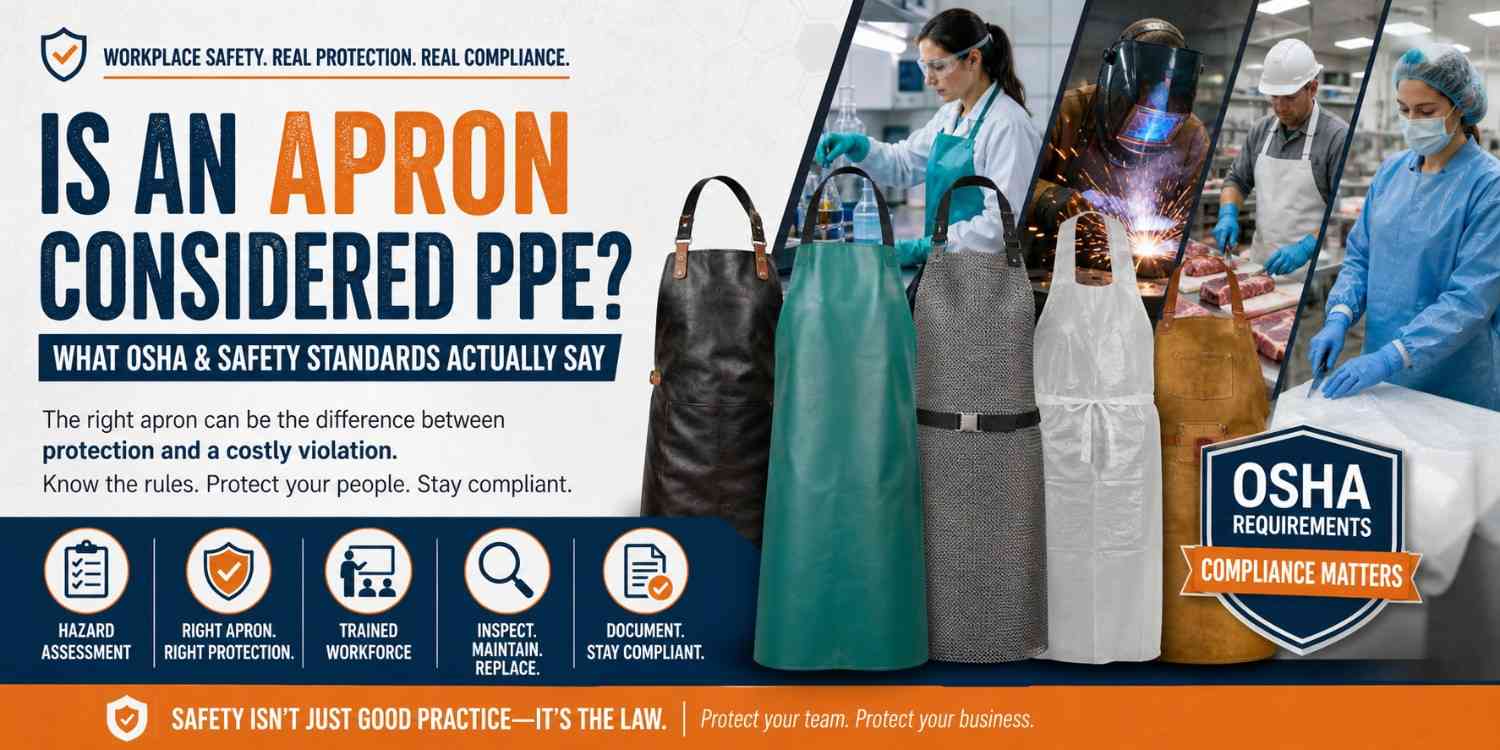
Your kitchen apron and a chemical lab’s protective garment may look similar, but legally and functionally, they could not be more different. Whether you are a safety manager, a small business owner, or a worker on the floor, knowing where your apron falls on the PPE spectrum might be the difference between compliance and a costly OSHA penalty.
What Is PPE? Understanding the OSHA Definition
Before we know if an apron is PPE, we must first understand what OSHA means by “Personal Protective Equipment.”
OSHA’s official PPE standard (29 CFR 1910.132)
According to OSHA’s General Industry Standard 29 CFR 1910.132, PPE is defined as equipment worn to reduce exposure to risks that might cause serious workplace injuries and illnesses. These risks can arise from exposure to chemical, radioactive, physical, electrical, mechanical, or other job hazards.
The key phrase here is hazard. PPE is defined by what it protects against, not by its appearance. A hard hat is considered PPE. Safety goggles are considered PPE. A disposable paper apron distributed at a craft fair is not.
The “Hazard Assessment” Requirement
OSHA requires companies to complete a workplace danger study before determining which Hazardous PPE is required. This written assessment must identify the hazards and assign suitable protective equipment to each. Aprons may or may not be included on that list, and this conclusion is legally significant.
Think of it like a seatbelt. Every automobile has one, but it only counts as a life-saving safety feature if it is built and tested to resist impact forces. A beautiful ribbon tied across your lap appears similar, but provides no protection.
So, Is an Apron Considered PPE? The Short Answer
Yes—but only under certain conditions.
Aprons are considered PPE when they:
- Designed specifically to defend against specified job dangers.
- Made with appropriate materials for the hazard kind (chemical resistance, flame resistance, cut resistance, etc.).
- Part of a recorded PPE programmed needed by a hazard assessment.
- Compliant with applicable ANSI/ISEA or industry-specific standards
A common cotton apron used in restaurants to keep chefs’ uniforms clean? Not PPE. A welder wears a flame-resistant (FR) apron to shield himself from molten metal spatter. PPE is probably necessary.
The “Incidental vs. Protective” Distinction
OSHA distinguishes between equipment used for incidental protection (cleanliness, convenience, and aesthetics) and equipment meant to mitigate hazards. The former is an operational tool, whereas the latter is personal protective equipment (PPE), which comes with all of the associated training, documentation, and employer-provided requirements.
Industries Where Aprons Qualify as Required PPE
Aprons are not optional accessories in many businesses; they are required safety equipment, as mandated by specific OSHA requirements and industry laws.
Chemical and Laboratory Environments
Workers at laboratories and chemical processing plants are protected from corrosive splashes, acid burns, and dangerous substance exposure by chemical-resistant aprons made of neoprene, PVC, or rubber. When splash hazards are identified on SDS (Safety Data Sheets), these aprons become a clear PPE requirement under OSHA’s Hazard Communication Standard (HazCom, 29 CFR 1910.1200) and the PPE standard.
For example, a pharmaceutical lab technician who works with strong sulfuric acid must wear a full-front chemical apron. If the employer fails to supply it, it is an OSHA violation, not simply bad practice.
Welding and Metal Fabrication
OSHA Standard 29 CFR 1910.252 (Welding, Cutting, and Brazing) specifies protective apparel for workers who are exposed to radiant energy, sparks, or molten metal. Leather aprons are the gold standard here, shielding the torso and thighs from burns that regular work clothes cannot tolerate.
A leather welding apron is similar to a computer firewall; it does not block every danger, but it does absorb and deflect the most harmful ones before they reach what matters.
Food Processing and Meatpacking
Workers in OSHA-regulated food processing areas are protected from slicing accidents using cut-resistant aprons composed of chainmail or high-performance polyethylene fiber. The meatpacking business has one of the highest injury rates of any industry, and cut-resistant PPE, including aprons, is a legally mandated necessity.
Healthcare and Biohazard Environments
Fluid-resistant or impermeable aprons are used in medical settings to protect healthcare workers from bloodborne infections in accordance with OSHA’s Bloodborne infections Standard. These disposable or reusable aprons are considered formal PPE and must be provided by the employer, trained, and disposed of appropriately.
You make like – Types of Industrial Aprons and Their Uses in Workplace Safety
What OSHA Says About Employer Responsibilities for PPE Aprons
If an apron is classified as PPE in your workplace, the statutory requirements change dramatically – for the employer.
Employers Must Provide PPE at No Cost
Employers are obligated by 29 CFR 1910.132(h) to offer the majority of PPE to their employees for free. If your hazard assessment identifies the requirement for chemical-resistant aprons, you cannot require employees to purchase their own. This is a prevalent OSHA violation in small firms that mislabel personal protective equipment as “personal items.”
Read – The Real Cost of Workplace Injuries Without PPE
Training Is Non-Negotiable
Employers must train employees on:
- When PPE apron use is required.
- What kind of apron is needed for various hazards?
- How to correctly don, doff, adjust, and wear an apron.
- Limitations to the apron’s protection
- How to Inspect and Maintain the Apron
Real-World Status: According to OSHA’s yearly enforcement data, PPE-related infractions are routinely among the top ten most often cited rules. Many of these breaches are the result of inadequate training, rather than a lack of equipment.
Documentation and Recordkeeping
The documented danger assessment that certifies PPE requirements must be signed and dated. It should specify the workplace being examined, the person who conducted the assessment, and the date. This is your compliance documentation trail.
Choosing the Right Protective Apron: Materials and Standards
Not all protective aprons are created equally. Selecting the incorrect material for the hazard is as risky as not wearing an apron at all.
Key Material Types and Their Hazard Match
| Material | Best For | Key Standard |
| Leather | Welding, grinding, heat | ANSI/ISEA 105 |
| Neoprene/PVC | Chemical splash, acids | ASTM F903 |
| Chainmail / HPPE | Cut/slash hazards | ANSI/ISEA 105-2016 |
| Disposable Poly | Biohazard, bloodborne | OSHA 29 CFR 1910.1030 |
| Flame-Resistant (FR) fabric | Flash fire, arc flash | NFPA 2112 / NFPA 70E |
ANSI/ISEA Standards to Know
The American National Standards Institute (ANSI) and the International Safety Equipment Association (ISEA) provide standards that establish performance norms for protective garments, such as aprons. When purchasing PPE aprons, look for conformity indicators against applicable ASTM or ANSI standards; this ensures that the product has been evaluated for the protection it offers.
Similarity: Purchasing a non-certified protective apron for chemical work is analogous to purchasing a bike helmet with no safety rating: it may appear to be the part, but there is no evidence that it will perform when it counts.
Common Misconceptions About Aprons and PPE
Even experienced safety specialists occasionally get this wrong. Here are the most common myths, addressed.
Myth No. 1: “Any apron is better than nothing.”
False. In a chemical environment, a cotton apron can absorb dangerous compounds and hold them on the skin, worsening the injury compared to not wearing one at all. The improper PPE can lead to a false sense of security.
Myth No 2: “If workers buy their own, we are covered.”
False. If the apron is needed for PPE, OSHA requires the employer to provide it at no cost. Allowing employees to source their own eliminates your capacity to ensure compliance with specified material or performance criteria.
Myth 3: “Our industry doesn’t need formal PPE documentation.”
False. Every general industry employer subject to OSHA jurisdiction must undertake a hazard assessment. The paperwork requirement is applicable regardless of company size or industry sector.
How to Build a Compliant PPE Program That Includes Aprons
Step 1: Conduct a written Hazard Assessment.
Explore the facility. Identify all employment tasks and exposure points. Document any chemical, physical, and biological dangers. This is your basis.
Step 2: Match the hazards to the PPE requirements.
Determine the appropriate amount of protection using OSHA guidelines and SDS information. If aprons appear on that list, classify them as PPE.
Step 3: Choose certified, standard-compliant aprons
Aprons that have been documented as meeting applicable ANSI, ASTM, or NFPA standards. Maintain purchase records.
Step 4: Train, document, and refresh.
Provide formal PPE training. Document attendance and content. Refresh training if hazards change, job roles vary, or weaknesses are discovered.
Step 5: Inspect and replace
PPE degrades. Create a schedule for apron inspection, cleaning, and replacement. A fractured chemical apron is no longer considered personal protective equipment (PPE), but a liability.
Conclusion: Don’t Let the Simplicity of an Apron Fool You
An apron is one of the most deceptively simple pieces of protective equipment in the workplace, yet its simplicity is precisely what leads to compliance failure. Its status as PPE is established not by its appearance, but by the hazard it is intended to eliminate and whether it meets the necessary standards.
If your employees are exposed to chemical splashes, heat burns, cut dangers, or biological exposure, wearing the appropriate apron is a legal requirement under OSHA guidelines. Treat it with the same rigor as any other PPE in your program.
Are you ready to audit your personal protective equipment program? Begin with your hazard assessment today. Review every job assignment, cross-reference your SDS library, and ensure that every apron in your plant is performing its intended function – or replace it with one that will.
Need assistance developing a compliance PPE program? Consult a certified safety professional (CSP) or contact your regional OSHA compliance assistance specialist; many provide free consultations to small firms.