

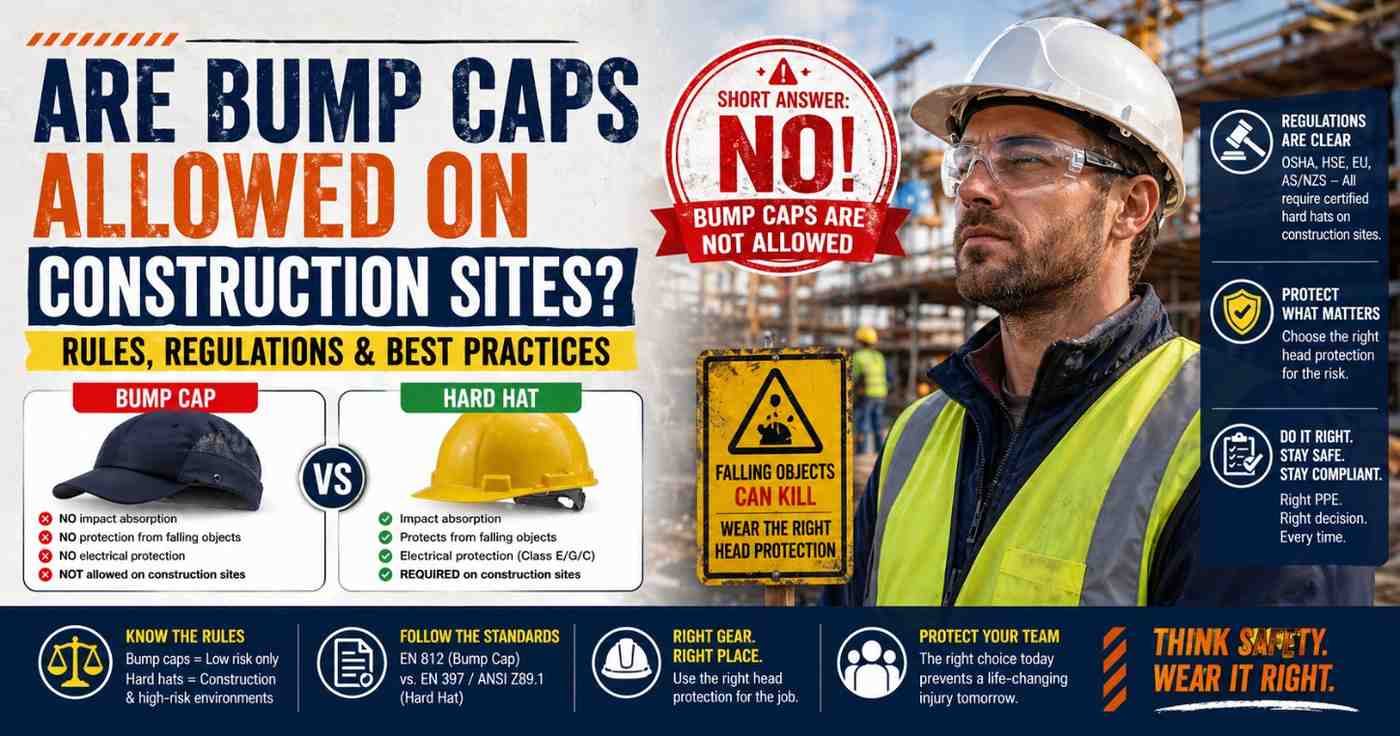
You have seen bump caps on warehouse workers and manufacturing floor employees. They appear convenient, are lighter than hard hats, and are comfortable to wear all day. So it’s logical to question if you can wear one on a building site, too.
The short answer is: no. However, understanding why is as crucial as learning the rule itself. This tutorial explains what bump caps genuinely protect against, what the restrictions are, where they are permitted, and what occurs when someone wears the incorrect head protection for the task.
What Is a Bump Cap, Exactly?
A bump cap resembles a baseball cap or a hard-shell hat, but it features a thin plastic insert inside the crown. That insert is intended to protect your head from mild impacts, such as walking into a low pipe, brushing against a shelf, or scraping your head under a machine.
That is it. That is all a bump cap does.
- It lacks impact absorption.
- It provides no protection against falling objects.
- It will not protect you if anything heavy falls on your head from above.
- Additionally, it provides no electrical insulation.
The fundamental reality about bump caps is that they prevent your head from hitting something. They do not protect you from objects hitting your head. On a building site, the danger is usually always of the second category, which requires a certified hard hat.
What the Regulations Say
Most countries enforce severe head protection rules on construction sites. Bump caps do not meet any of the requirements for high-risk situations.
In the USA (OSHA)
OSHA’s construction regulation (29 CFR 1926.100) requires workers to wear ANSI/ISEA Z89.1-compliant head protection anytime there is a risk of head injury from impact, falling or flying items, or electric hazards. Bump caps are not rated under Z89.1, and so do not meet this criteria. Wearing a bump cap on a US construction job where head protection is required is a blatant violation of OSHA standards.
In the United Kingdom (HSE)
The UK’s Health and Safety Executive is also clear. Under the Personal Protective Equipment at Work Regulations, head protection on construction sites must meet EN 397, the European Safety standard for industrial safety helmets. Bump caps are subject to a completely distinct standard (EN 812), which states specifically that they are only intended for low-risk environments. EN 812 and EN 397 are not interchangeable. HSE guidelines clearly warn that bump caps should not be used in areas where there is a risk of falling objects.
In the European Union
The European Union’s PPE Regulation (EU 2016/425) classifies head protection based on danger level. EN 397 helmets are designed for use in construction and industrial situations where overhead risks exist. EN 812 bump caps are designed for light industrial applications with bumping hazards only. Using EN 812 equipment in an EN 397 setting is non-compliant and leaves both the worker and the employer liable.
In Australia and Other Regions
The AS/NZS 1801 standard in Australia controls industrial safety helmets and similarly prohibits the use of bump caps on construction sites. Most countries with formal safety legislation operate on the same principle: if there is a possibility of objects falling on workers, a rated hard hat is required.
If a worker is harmed on a construction site while wearing a bump cap rather than a compliance hard hat, the business will face serious legal and financial consequences, regardless of who made the decision to wear it.
Bump Cap vs. Hard Hat: The Real Difference
People sometimes assume that these two things provide comparable protection at different price points. They do not. They are fundamentally different products, designed for quite different situations. The bump cap vs. hard hat comparison guide provides a comprehensive explanation of how these two compare across all specifications.
| Feature | Bump Cap | Hard Hat |
| Standard / certification | EN 812 / ANSI (non-impact) | EN 397 / ANSI Z89.1 |
| Falling object protection | No | Yes |
| Impact absorption | Minimal / none | Yes — tested to standard |
| Electrical hazard rating | No | Class E / G available |
| Penetration resistance | No | Yes |
| Low-clearance bump protection | Yes | Yes (partial) |
| Allowed on construction sites | No | Yes |
| Allowed in warehouses / light industry | Yes (where appropriate) | Yes |
Where Are Bump Caps Actually Allowed?
Bump caps are a legitimate piece of PPE, but not for building. They exist for a reason, and they are appropriate in real-world situations.
They function well in situations when workers are moving swiftly through low-clearance places and the major risk is accidentally striking their own head on something fixed, rather than being hit from above or with force.
Suitable environments for bump caps
Food production and processing facilities — Workers in food manufacturing and processing facilities frequently move under low conveyor belts, machinery, and storage racks. The risk is scraping your skull, not falling objects. Bump caps function effectively and are more sanitary than hard helmets in food-grade situations.
Vehicle maintenance and automotive workshops — Mechanics who operate beneath autos and trucks in inspection pits or on lifts encounter low clearance hazards. A bump cap provides protection from hitting your head on an undercarriage without the bulk of a hard hat.
Light manufacturing and assembly lines—When overhead threats are fixed structures rather than falling objects, a bump cap may be suitable provided a formal risk assessment supports it.
Warehouses with low-level racking — Bump caps may be acceptable in warehouses with low-level racking that do not have an overhead dropping hazard. However, many contemporary warehouses now require full hard helmets due to forklift activities and overhead storage; always consult the site’s risk assessment.
A bump cap should only be used when a formal risk assessment verifies that there is no risk of things falling on or striking the worker’s head from above. If such a risk exists, even if it is rare or unlikely, a hard helmet is essential.
Why Some Workers Prefer Bump Caps (And Why That’s a Problem)
It’s critical to understand why workers choose bump caps in situations where they aren’t appropriate. The reasons are practical, yet they can pose significant safety dangers.
Comfort:
Bump caps are lightweight, breathable, and feel like ordinary caps. They are significantly more comfortable in hot or restricted conditions than hard hats, which can feel weighty and restricting during lengthy shifts.
Convenience:
They are simple to put on and take off, and they do not restrict movement significantly. Workers may believe that a bump cap is adequate for “low-risk” tasks.
Habit:
Workers who frequently wear bump caps in warehouses or factories may continue to wear them while transitioning to construction-related duties, especially if no explicit instructions are provided to replace PPE.
These reasons are acceptable, yet they lead to a false sense of security.
Bump caps are only intended to protect against minor bumps and scrapes from fixed objects. It does not provide impact absorption, penetration resistance, or protection against falling or moving threats. On a building site, where overhanging threats are widespread, this constraint becomes hazardous.
This is where the mistake often arises: workers believe that because a bump cap covers the head, it provides equal protection to a hard helmet. In actuality, the difference is not in coverage but in impact protection capability.
A hard helmet has a suspension system that absorbs and distributes force. A bump cap doesn’t. If a falling object impacts your head, it transfers its energy directly to you.
That distinction is only noticeable after a single encounter.
If a Bump Cap Isn’t Enough, What Should You Use?
Once it is obvious that a bump cap cannot withstand construction risks, the next step is to determine the appropriate amount of protection.
A certified hard hat is necessary in construction workplaces that may involve falling objects, collision, or electrical exposure. Unlike bump caps, hard helmets are intended to absorb impact and guard against major head injuries.
However, not every hard hat provides the same level of protection. The type required depends on the threats prevalent on your site.
Hard Hat Classes You Need to Know
Class E (Electric) – Protects against high-voltage electrical threats (up to 20,000 volts). Common in the electrical and utility industries.
Class G (general) – Provides protection up to 2,200 volts. Suitable for most common building situations.
Class C (Conductive) – Does not offer electrical protection. Used only in areas where no electrical risks exist yet impact protection is still required.
The hard hat classes and color codes guide provides a detailed explanation of each class and the settings for which it is designed.
Why This Matters in a Bump Cap Discussion
This is where many employees make significant mistakes.
They substitute a bump cap with any hard hat, presuming that all hard hats provide equivalent protection. However, much as bump caps are only appropriate for low-risk areas, each hard hat class is intended for specific risks.
Choosing the wrong type of hard hat might expose you, especially in electrically hazardous areas.
Conclusion
Bump caps are not permitted on construction sites—not under OSHA, HSE, EU laws, or Australian norms. They provide protection against minor scrapes and bumps in low-hazard areas. Construction sites are not that environment. If there is a chance of something falling on or striking a worker’s head, the only compliant solution is a certified hard hat with the appropriate class rating for the hazards present.