

Have you ever stuck in a safety supply line looking at face shields and goggles? Wondering which one to take, you’re not alone. They both cover your face and eyes, and they frequently sit next to each other on the shelf. At first glance, they may appear very similar. But they are not the same thing, and choosing the wrong one will expose you to the very peril you were attempting to avoid.
This guide explains what each one accomplishes, where they fit in, and how to make an informed decision.
Let’s Start with the Basic Difference
The simplest way for understanding the difference is this:
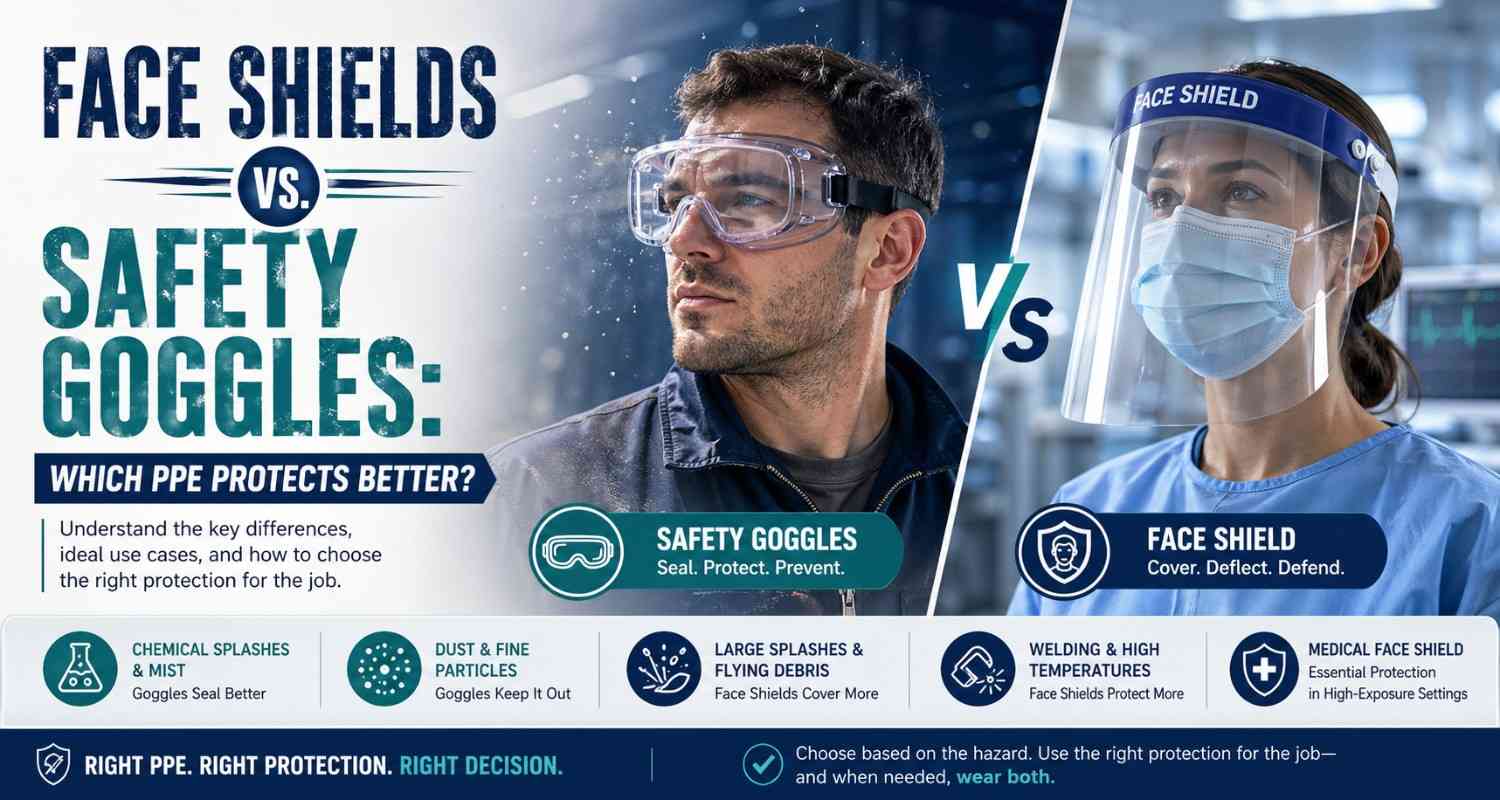
Goggles are designed to seal against your face. Face shields do not.
That single distinction governs practically everything about when to use which.
Safety goggles fit snugly against your skin, creating a closed barrier around your eyes. Nothing enters via the sides, top, or bottom—not air, mist, or tiny dust. The airtight fit is the entire point.
Face shields are placed on a headband or helmet to keep them away from your face. They cover your entire face—eyes, nose, cheeks, and chin—but are open at the edges. Air and tiny particles can still come in. They are really good at shielding huge splashes, flying debris, and strikes across your full face.
So, if someone asks, “Which is better?” The honest answer is that it all depends on what you are defending yourself from.
When You Need Goggles
Goggles are the best option when the threat is small and flying — something that may slip past the borders of a face shield and still reach your eyes.
Chemical splash and mist
Goggles are required while working with acids, solvents, cleaning chemicals, or any liquid that sprays or evaporates. A face shield alone will not suffice here. Chemical mist can easily float in through the open sides and still get into your eyes. Only the goggles’ sealed design prevents this.
Grinding and cutting metal
Angle grinders eject sparks and metal particles in all directions, including above and sideways. Goggles wrap around and close up the angles that a face shield leaves open. Goggles are often required by law for this type of job, rather than being an optional accessory.
Dusty surroundings
Fine dust from woodworking, construction, and agriculture gets everywhere. It travels on air currents, rises from the ground, and floats in unexpected directions. Goggles keep it out of your eyes, however a face shield lacks a sealed edge to prevent it.
When You Need a Face Shield
Face shields are appropriate when the hazard is larger, faster, or more likely to strike your entire face rather than just your eyes.
Large liquid splashes
If you’re pouring chemicals from huge containers, working in a meat processing plant, or in any circumstance where a significant splash could occur, you should wear a face protection. It protects your nose, mouth, and chin, regions that goggles do not cover. A face full of caustic liquid is a devastating injury, even if your eyes are protected by goggles.
Welding and high temperature work
Welding emits UV rays, infrared light, and molten spatter, which all strike your entire face, not just your eyes. A proper welding face shield (with the appropriate optical filter for the procedure) is specially built for this purpose. Standard goggles do not provide adequate coverage or filtration for welding tasks. Just as you would choose purpose-built welding gloves over ordinary work gloves, your facial protection should be job-specific.
Powered tools and flying debris
Chainsaws, nail guns, chipping hammers, and lathes are all capable of throwing debris at your chin and nose, as well as your eyes. A face shield covers the entire target area. Goggles alone are insufficient for this type of activity since they expose too much of your face.
Healthcare and clinical contexts
Face shields are essential in healthcare contexts because they protect the face from blood, body fluids, and infectious droplets while performing medical procedures. They are frequently combined with masks and goggles to form a layered defense system, ensuring greater safety in high-risk and high-exposure scenarios. A medical face shield provides an additional barrier, lowering the risk of contamination and improving overall protection for healthcare personnel.
Quick Comparison – Face Shields vs Goggles
| What you are comparing | Safety Goggles | Face Shield |
| What it covers | Eyes only | Full face |
| Seals against face | Yes | No |
| Stops chemical mist/vapor | Yes | No |
| Stops fine dust | Yes | No |
| Stops large splashes (full face) | Eyes only | Yes |
| Stops flying debris (full face) | Eyes only | Yes |
| Good for welding | No | Yes |
| Fits over prescription glasses | Some models | Most models |
| Tends to fog up | More likely | Less likely |
Can You Wear Both (Face Shields & Goggles) at Once?
Yes, and for some positions, you definitely should.
Wearing sealed goggles inside a face shield is recommended in chemical labs, industrial cleaning, and metal grinding applications. The goggles tackle fine and airborne threats, whereas the face shield handles large and fast ones. They are addressing two different issues at the same time.
It may seem like overkill until the day it isn’t. The discomfort of wearing both is minimal compared to a chemical burn on the face that a face shield alone would not have prevented.
Use These for the Right Job
Goggles are used when:
- You are handling chemicals or solvents.
- Fine dust or particles are in the air.
- You are grinding or machining metal.
- Vapor or mist exposure poses a concern.
- You need a sealed fit around the eyes.
Face shields are used when:
- Large droplets can impact your entire face.
- You are welding or operating with extreme temperatures.
- Flying debris presents a full-face risk.
- You wear glasses below.
- You need covering beneath your eyes.
What About Standards and Ratings?
Both goggles and face shields have safety ratings printed right into the lens or frame. In the United States, the relevant standard is ANSI/ISEA Z87.1. Search for markings such as D3 (dust protection), D4 (splash protection), and D5 (fine dust). A goggle stamped D3 is not automatically qualified for chemical splash; the marking indicates exactly what it was tested for, so check it before purchasing.
In the United Kingdom and the European Union, EN 166 covers the majority of eye and facial protection. EN 1731 relates primarily to mesh-type visors on face shields. These aren’t just formalities; they confirm that the device has been independently tested for the harm it claims to prevent.
If you are not sure which rating you need, consult your safety data sheet (SDS) for the chemical or material you’re dealing with. It will outline the minimal PPE requirements. Follow that, not the overall recommendation.
One Thing People Often Get Wrong
What’s the most prevalent mistake? Assuming a face shield provides “more protection” by covering more of your face.
Covering a larger area does not imply covering all types of hazards. A face shield gives little protection against toxic mist that enters through its open sides. A worker who chooses a face shield over goggles because “it covers more” is actually less protected from the specific risk they confront.
Greater coverage equals better coverage. The appropriate protection fits the real hazard—nothing more, nothing less. This is true for all PPE categories. The same principle applies to selecting the right type of PPE for every task: the hazard always drives the decision.
Reusable vs. Disposable Face Shield: Does It Matter Here?
For face shields, yes. Disposable face shields in healthcare and food contexts help to limit the danger of cross-contamination between patients and workplaces. In industrial environments, reusable models with replacement lenses are more convenient and provide higher optical clarity over time.
For goggles, the seal condition is more important than whether they are reusable. If the foam or rubber seal surrounding the lens has flattened, split, or lost its flexibility, the goggle will no longer seal, therefore defeating its primary purpose. Inspect the seal before each usage, not just the lens.
You make like – A Simple Guide to Reusable and Disposable Face Shields
Consclusion
Face shields and safety goggles are not competitive items; they protect against separate hazards. Goggles keep out the small and airborne. Face shields deflect the large and rapid. For many jobs, employing both together is the best solution. The only bad choice is to take whichever one is closest without considering what you actually need protection from.