

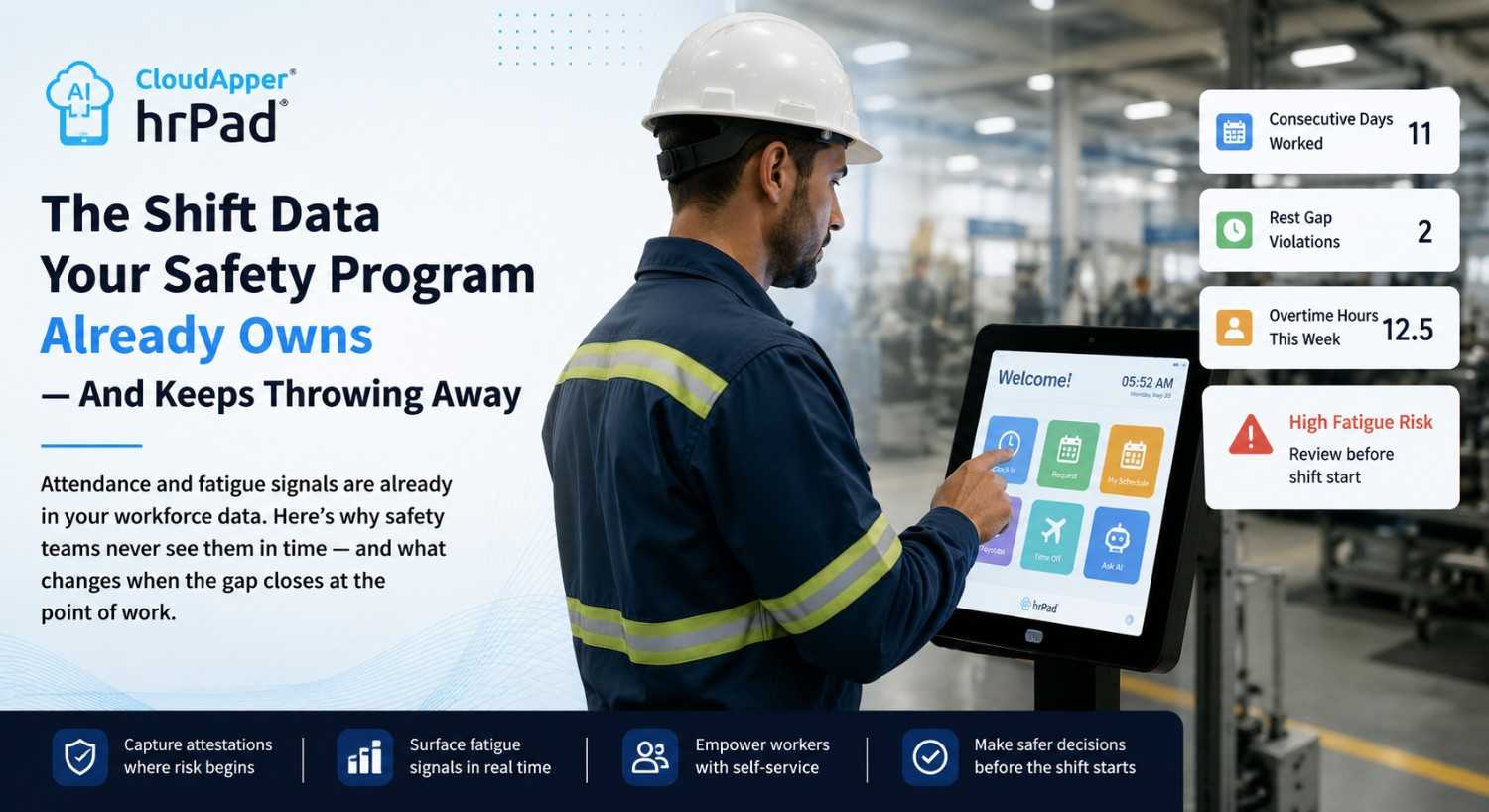
Ask a safety manager on a shift-based line what puts a worker at risk today, and you’ll get a good answer: the pinch point, the blind corner, the forklift aisle that gets busy at shift change. Ask who on the floor right now is on their eleventh consecutive day, covering a second unplanned absence this week, or three hours into an overtime block they didn’t plan for — and the answer changes. Usually it’s some version of we’d have to pull a report.
That gap is the story. The signals that predict a fatigued, distracted, overextended worker are not missing. They already exist, in high fidelity, inside the workforce systems the organization paid for. They just live somewhere the safety function can’t reach in time to act.
Fatigue is a scheduling artifact before it’s a human failure
Occupational health researchers, including NIOSH, have spent decades documenting what long hours, compressed rest windows, and rotating night work do to reaction time, judgment, and error rates. None of that is contested. What’s changed is that most operations now know exactly how their hours are distributed — and still treat fatigue as a behavioral issue to train out of people.
Consider what a workforce system already records, shift by shift: consecutive days worked, unplanned overtime, punch-in times drifting later, rest gaps between an evening-shift out-punch and a morning-shift in-punch, absence clustering on one line, one crew, one supervisor’s team. Read individually, each is a payroll detail. Read together, they describe a line that is running hot — and a crew whose margin for error has quietly narrowed.
The problem is that this data is stored for payroll and compliance, not for prevention. It is complete, accurate, and retrospective. Safety teams meet it after the incident, when someone finally pulls the timecard history and finds the pattern that had been visible for three weeks.
Why the reports never arrive in time
Every mature operation has an HCM or workforce management platform. Those systems are extraordinarily good at what they were built for: recording what happened. They were not built to interpret what’s about to happen next, and they were not built to put that interpretation in front of a supervisor at 5:52 a.m. before the line starts.
So organizations improvise. A spreadsheet an analyst rebuilds monthly. A dashboard request that enters the IT backlog behind eleven other things. A vendor enhancement scheduled for a release next year. Meanwhile a supervisor makes the real fatigue decision — who covers the gap, who stays another four hours — in about ninety seconds, with whatever is physically in front of them. Usually a clipboard and a phone call.
This is the gap between the system of record and the work itself. It’s not a data problem. It’s a delivery problem, and it’s where safety programs lose ground they never get back.
Closing the loop at the point of work
The intervention point isn’t the quarterly review. It’s the moment the shift starts.
That’s the logic behind CloudApper hrPad, a tablet-based platform that sits at the entrance to the work itself. Workers clock in with Face ID and geofencing, request time off, check accruals, bid and swap shifts, and get answers from an AI assistant — without a supervisor line, without a paper form, without a laptop they don’t have. It runs on iOS, Android, or Windows hardware and syncs in real time with UKG, Workday, Oracle, SAP SuccessFactors, Dayforce, and the rest of the systems these operations already run.
For a safety function, three things change when that layer exists.
Attestations happen where the risk is. Fitness-for-duty confirmations, PPE checks, and policy acknowledgments are captured at clock-in — timestamped, tied to the worker and the location, and complete. Not a signature sheet reconstructed on Friday.
Fatigue signals surface before the shift, not after the incident. Consecutive-day counts, rest-gap violations, and overtime accumulation can be evaluated at the moment of punch, when the supervisor still has the ability to make a different call.
Workers get agency in the loop. Give someone a genuinely frictionless way to flag a conflict, swap a shift, or request time off — self-service that takes twenty seconds on a kiosk instead of a form and a wait — and fewer people show up exhausted because declining the shift felt harder than working it.
What this actually makes possible
The organizational gain is that safety stops being reactive. Fatigue risk becomes a metric the operation manages in the present tense, in the same conversation as throughput and coverage, rather than a finding that appears in a root-cause analysis.
The gain for supervisors is smaller and more immediate: the person making the hardest call of the day stops making it blind.
And the gain that matters most sits outside the org chart entirely. A worker on a shift-based line has almost no visibility into the scheduling decisions that shape how safe their next twelve hours will be. Closing that gap means fewer people carrying a risk nobody measured — and going home intact more often. That is a better outcome than any lagging indicator can describe.
CloudApper is the process layer that closes the gaps enterprise software can’t — across HR, ERP, and operations, on any platform, in weeks not quarters. Because the organizations that get safer fastest aren’t the ones with the biggest budgets or the best vendors. They’re the ones that stopped waiting for permission to close the gap.